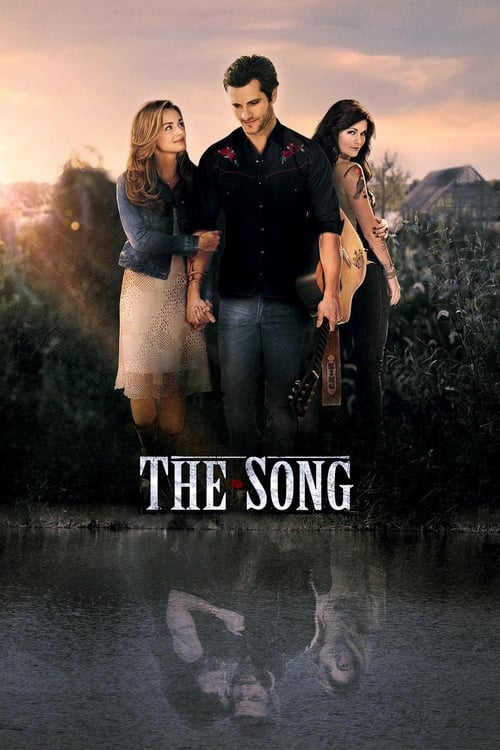
The Song (2014) is about a modern-day, country rocker King Solomon. Jed’s (Alan Powell) father had an affair with a woman named Bethany (based on King David’s second wife, Bathsheba), whom he later married. They had Jed, who grew up into a strapping young man, and then Jed’s dad died. All this backstory is dealt with in the movie’s first six minutes and plays like the recap of a film nobody made.
Jed meets, falls in love with, and marries Rose (Ali Faulkner), and they have a son, Ray (Jude Ramsay). Jed decides to build a chapel for no apparent reason other than that Solomon built the First Temple in Jerusalem (not personally with his bare hands, though).
Jed’s musical career takes off. He goes on tour with fellow musician Shelby Bale (Caitlin Nicol-Thomas), who is a stand-in for the Queen of Sheba. Nothing in the Bible suggests any impropriety during Solomon and the Queen’s brief meeting, but we know that Shelby is bad news because, unlike Rose, she has dark hair and a lot of tattoos.
Shelby introduces Jed to the joys of pill-popping and extramarital sex. Jed leaves his family, shacks up with Shelby, attempts suicide, goes to rehab, grows a fake-ass beard, quits the music business, and sets out to reunite with his family.
Rose is having none of that happy crappy, but then Jed goes onstage (this happens at one of the wine-tasting events that Rose’s family hosts) and sings Rose’s favorite song, Peter Seeger’s “Turn! Turn! Turn!” That’s all it takes to win her back.
There are a couple of problems with this development. First, there’s the empty gesture of singing a cover when it’s been established that Jed is an accomplished songwriter and has written at least one song inspired by Rose. Second, there’s the irony, lost on Rose (and possibly the filmmaker too, unless he just didn’t care), of Jed walking away from a stage (he had a show that very night) for Rose’s sake, only to walk onto another stage as a counterintuitive way to convince her that he’s done touring. It seems rather hypocritical and doesn’t bode well for Rose’s chances that Jed will truly stay home from now on. Then again, Rose is little more than a prop — specifically, a doormat who wouldn’t even go out with Jed until he asked her father’s permission. These aren’t teenagers we’re talking about, but grown-up people.
The movie has trouble reconciling its content with its context. The screenplay makes a big deal out of monogamy, for which Solomon is hardly the poster boy, having had, per the Bible, 700 wives and 300 concubines. This bothered God only to the extent that Solomon’s foreign wives turned him on to polytheism, and even then God waited until Solomon died to punish him by proxy through his son.
To be fair, for a faith-based drama, The Song keeps the bible thumping to a minimum. One of the few times the good book is brought up is precisely to point out that Seeger stole the lyrics to “Turn! Turn ! Turn!” from Ecclesiastes. On the other hand, the film attributes its epigraph directly to Solomon without any chapter or verse attached, and Solomon’s lifespan is given as “1000 - 931 BC,” as though he were an actual person whose historicity has been firmly established rather than a fictional biblical character. The quote turns out to also be from Ecclesiastes, never mind that if Solomon existed, it is highly unlikely that anything he said was recorded for posterity.
If Solomon truly lived, he lived not as depicted in the Bible; i.e., not nearly as rich, as wise, or as lecherous, and definitely closer to Jed than the larger-than-life biblical king. The names of the main characters also speak of a deliberate break from the biblical account. Rose obviously represents the only one of Solomon’s 1000 women whom the Bible mentions by name or as having borne him a child. Well, not so obvious considering that the name of that wife was Naamah. The name of their child, Solomon’s heir whom God punished in lieu of his father, Rehoboam, doesn’t instantly make you think of “Ray” either.
Jed’s name comes from Jedidiah, Solomon’s “second” name that was bestowed upon him by the prophet Nathan. I actually like that. It’s just one degree of separation, but it’s better than calling the character “Sol.” It’s a simple, elegant, and ingenious solution. I wish writer-director Richard L. Ramsey had thrown more curveballs like that. Of course, if he had wanted to keep the audience guessing, he never would have named Jed’s father David King (Aaron Benward).
I’m not a fan of quote-unquote loosely based stories, especially when they’re loosely based on the Bible. Not because it’s blasphemy, but because you can invariably spot the differences as easily as the similarities. What bothers me is not the artistic license, the questionable hermeneutics, or the untidy religious eclecticism so much as the fact that, all those smoke and mirrors notwithstanding, this film doesn’t aspire to be anything but a transparent parable.